Now I have totally 10 passenger cars of former JNR 457 series, ran them in my layout.
2 green cars (1st class passenger cars) and 2 buffet cars, which looks alike the good old days for old express trains. I ran it a bit slower than usual and found it was better than doing it faster as it looked as it was. I hope I can find 1 more basic set of 3 passenger cars with engines of this series to make 12 cars.
Hayaokidori website
Showing posts with label JNR (Japan National Railways). Show all posts
Showing posts with label JNR (Japan National Railways). Show all posts
Thursday, March 12, 2009


Thursday, March 13, 2008
EF64 at Shinonoi locomotive base
I went to Nagano city area today and found many locomotives so I sneaked up to them:)

EH200(left) and DE10? (right)

First time for me to see some real EH200. Very different from EH10. Feels as if I were living in a quite different age.

Lots of EF64!

A local train for Nagano just passed by the locomotive base. I met someone in the same hobby and talked about this and that. I thought this Shinonoi locomotive base was for trains went up and down the Ubasute but he told me this was a sub-base of Shiojiri main base. I guess perhaps Shiojiri was the base for trains went steep up/down hill at Chuo line. If I remember right, there used to be loco bases at Kamisuwa and Kiso-Fukushima as well. Probably there were more loco bases around a steep up/down hills lines than flat lines. Now Shiojiri locomotive base does not exist any more, so this Shinonoi locomotive base is an independent one. I found only one that had a yellow door at the front.

This yellow door at the front is unique enough to express that it was renewed in Hiroshima factory. The dark blue line at the bottom is also drawn lower than others. I even didn't notice that until when he told it to me. He also told me this loco belonged to Aichi base and only one that regularly pulls freight trains all the way here to Nagano.

Some of EF64 locomotives were just there doing nothing. Maybe their destiny is to be scrapped as the guy said?

EF64-55

Do electric locomotives also need some sand to avoid slipping at uphills? What is the stuff like a hose just beside the wheel and rail.

A EF64 holds 3 boggies, so wheels are located like B-B-B ( 2-2-2)
The side boggies have 2 springs each.

One thick and bigger spring at the middle boggie.

EF64-22

EF64-62

Says "built in 1973" 35 years old! It's in one's prime if they were human beings!

EF64-58

EF64-52.
It's how it goes old stuff retire when newbies show up. EF64 was born in more than 40 years ago in J.N.R (Japan National Railways) era to push/pull trains at the Itaya summit of Ouu main line before it was switched from Direct current to Alternate current. But now life is cruel, the last time gets close to them.........
Hayaokidori website
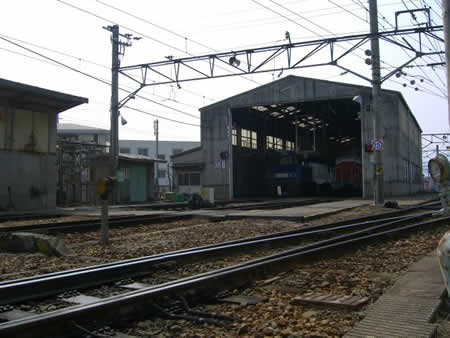
EH200(left) and DE10? (right)
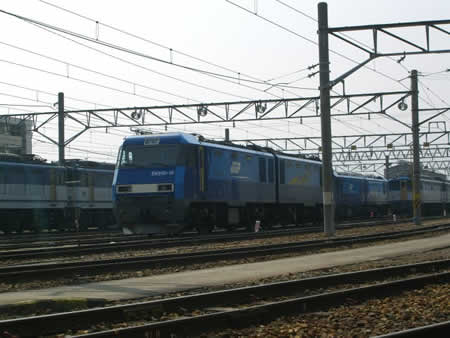
First time for me to see some real EH200. Very different from EH10. Feels as if I were living in a quite different age.
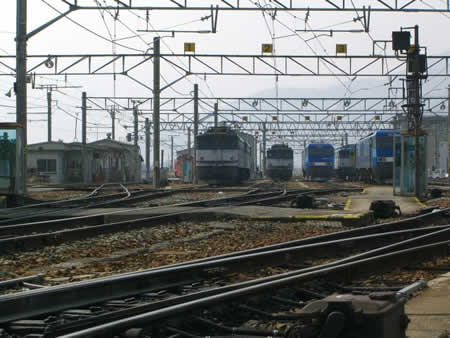
Lots of EF64!
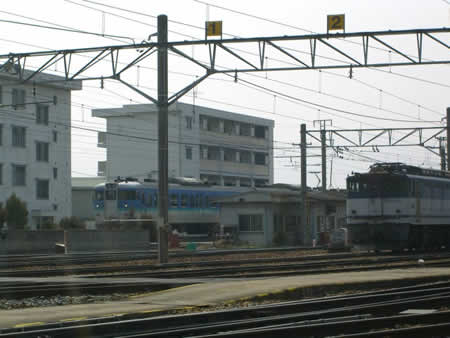
A local train for Nagano just passed by the locomotive base. I met someone in the same hobby and talked about this and that. I thought this Shinonoi locomotive base was for trains went up and down the Ubasute but he told me this was a sub-base of Shiojiri main base. I guess perhaps Shiojiri was the base for trains went steep up/down hill at Chuo line. If I remember right, there used to be loco bases at Kamisuwa and Kiso-Fukushima as well. Probably there were more loco bases around a steep up/down hills lines than flat lines. Now Shiojiri locomotive base does not exist any more, so this Shinonoi locomotive base is an independent one. I found only one that had a yellow door at the front.
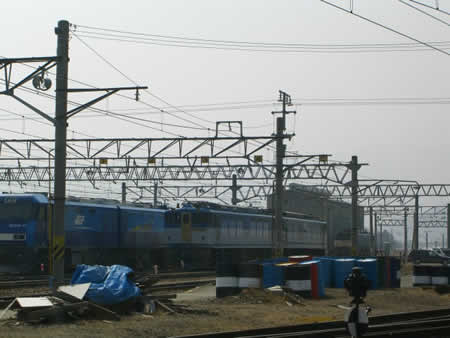
This yellow door at the front is unique enough to express that it was renewed in Hiroshima factory. The dark blue line at the bottom is also drawn lower than others. I even didn't notice that until when he told it to me. He also told me this loco belonged to Aichi base and only one that regularly pulls freight trains all the way here to Nagano.
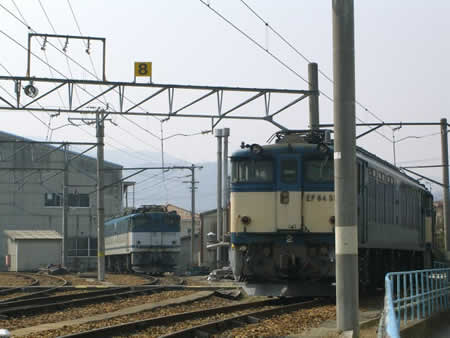
Some of EF64 locomotives were just there doing nothing. Maybe their destiny is to be scrapped as the guy said?
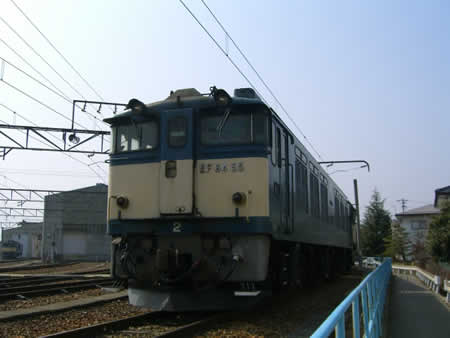
EF64-55
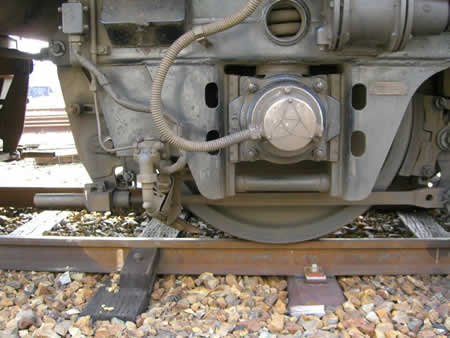
Do electric locomotives also need some sand to avoid slipping at uphills? What is the stuff like a hose just beside the wheel and rail.
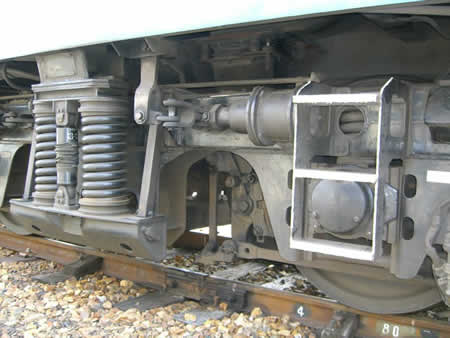
A EF64 holds 3 boggies, so wheels are located like B-B-B ( 2-2-2)
The side boggies have 2 springs each.
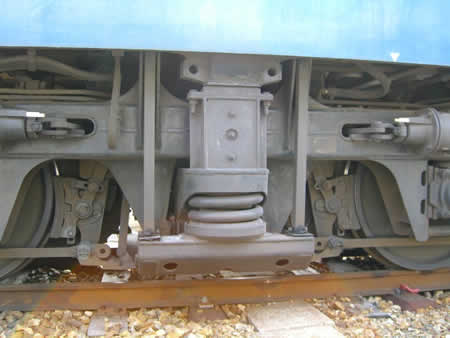
One thick and bigger spring at the middle boggie.
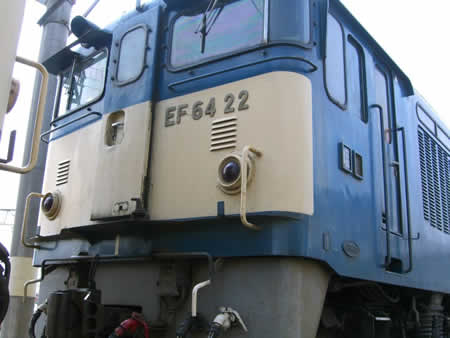
EF64-22
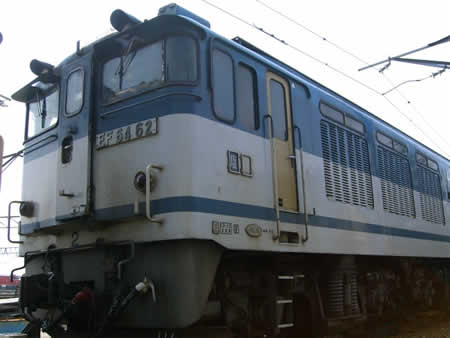
EF64-62
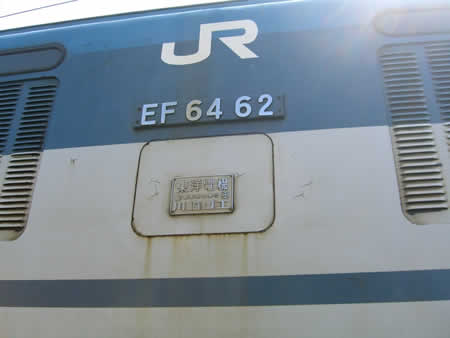
Says "built in 1973" 35 years old! It's in one's prime if they were human beings!
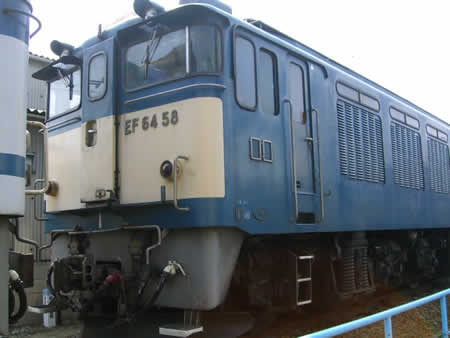
EF64-58
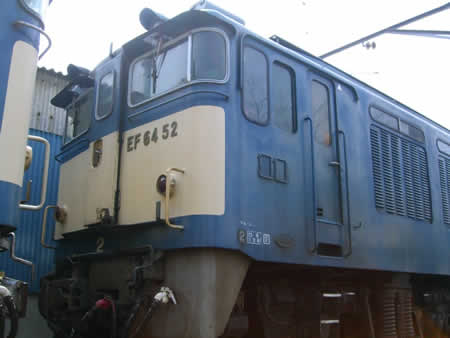
EF64-52.
It's how it goes old stuff retire when newbies show up. EF64 was born in more than 40 years ago in J.N.R (Japan National Railways) era to push/pull trains at the Itaya summit of Ouu main line before it was switched from Direct current to Alternate current. But now life is cruel, the last time gets close to them.........
Hayaokidori website
Wednesday, December 19, 2007
Bonnet express "Hibari (Skylark)" arrived at Fukushima station.

I took this picture at Fukushima station when I traveled around Tohoku region with friends in 1977. Platform roof, overbridge etc show us some railroad structures of the good old days :-)
Hayaokidori website
Tuesday, December 4, 2007
Minami Oomachi station
A tiny station called "Minami Oomachi" located just 1 next of Shinano Oomachi. I know some people say train stations have to be a lot bigger, not like this. But in Japan train stations are often like this especially in countryside.

This is Matsumoto direction.

Shinano Oomachi direction.

Some broad steps. Actually there is a factory of a company at the opposite side of a main route just infront of the station. I guess probably a lot of people commuted there by train before.

400 yen for Kamishiro where we are located.

You have to reach a station enough earlier than the train arrives there in Nagano prefecture because not so many services available here. Otherwise you have to wait for next train for a long time!!
Hayaokidori website
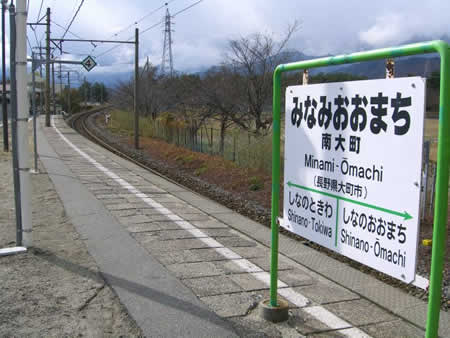
This is Matsumoto direction.
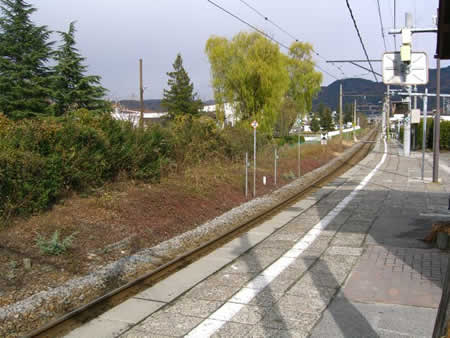
Shinano Oomachi direction.
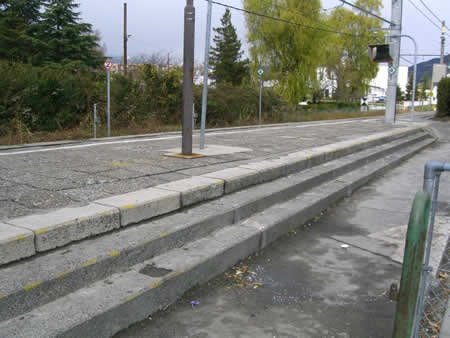
Some broad steps. Actually there is a factory of a company at the opposite side of a main route just infront of the station. I guess probably a lot of people commuted there by train before.
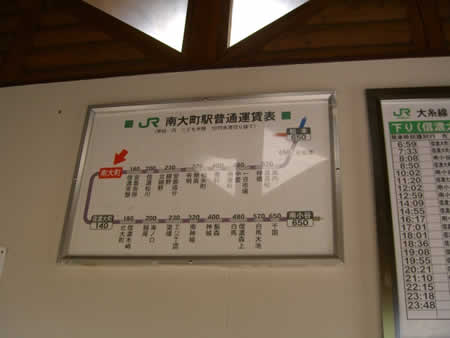
400 yen for Kamishiro where we are located.
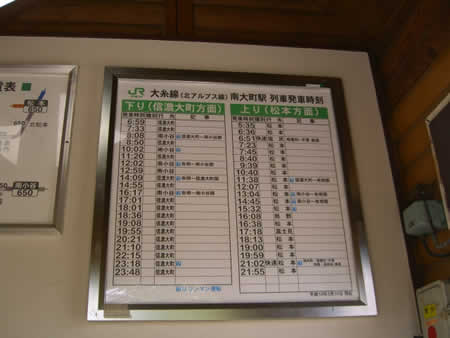
You have to reach a station enough earlier than the train arrives there in Nagano prefecture because not so many services available here. Otherwise you have to wait for next train for a long time!!
Hayaokidori website
Tuesday, October 9, 2007
Kiha 81 retiring day
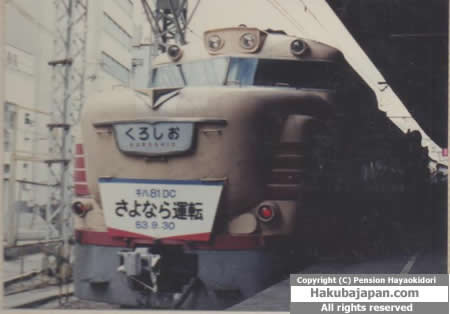
The pioneer of DMU limited express train kiha81. Debut for "Hatsukari" which connected Ueno terminal in Tokyo to Aomori in 1960. After "Hatsukari" got EMU in 1968, this DMU was transfered as "Inaho" and "Hitachi" then finally "Kuroshio". Less than 20 years life.

Probably this design was affected by EMU 151 series control car at that time which connected Tokyo and Osaka before Shinkansen (bullet train) started providing their service.
Hayaokidori website
Wednesday, August 22, 2007
The final stage for old train cars.
Found some when I rearranged stuff.

I don't remember what this serioes was. Maybe one of Kumoha 32 , 41, 51, 61 something like that. Anyway old JNR EMU train cars were unique each. It was also fun to learn which was which and what was different.
Local trains on Keihanshin-kanko line (Nishi-akashi <--> Kyoto) at the Yodogawa river railroad bridge.


At that time, Keihanshin-kanko line local trains were already 7 train cars ones. With this type of old train cars, usually they made it 4+3. 4 at Nishi-Akashi side and 3 at Kyoto side to make 7. Sometimes I found all the 7 had control rooms at either side. In short, I guess they cared the control room of the 4th train car was forwarded Kyoto side and one of the 5th train cars was forwarded Nishi-Akashi side but didn't care others lol... It was fun to see for a kid. Old train cars at that time were all unique. Some had toilet, some had benches for people to be face to face in a limited space along window side. (We call it "box" sheet here in Japan) And some older ones showed a lot of rivets at their surfaces. Some had 4 doors on their side and others had 3. So wonder how they showed where the doors would be at the platform at that time. Can not check it as time has passed so long :o
As some short run train which ran from Koshienguchi <--> Suita were only 4 train cars, I guess they needed to make 7 with 4 + 3 to adapt it.
In both pics above, a Kuha79 is at the head. Depends on when they were made, their exterior and interior were slightly different as you see. I guess following cars were Moha72 etc. They didn't hang signboards to show their destination, did they?
This kind of old train cars had been replaced into 103 series commutor cars since 1969. If I remember right, they were completely replaced around 1977-1978.
I think these 2 pictures above were taken at the same date with the one of 481 series red skirt "Shioji" limited express train I showed while long ago, probably it was around 1972-73. Because 481 series was not in charge for "Shioji" limited express train in 1971 or before when 181 series train stayed in Mukomachi train cneter.
Diesel cars for express train. Kiha 65

Thought this one below would be a kiha 58 Diesel car but...

I guess there's a description which says "Kiha 57 4" at its side. Kiha 57 series was made to pass the Usui summit, this kiha 57 series DMU were phantoms and had air-suspensions at their boggies while their "buddy" series kiha 58 / 28 series didn't. If thr green car ( 1st class passenger car ) in the pic of kiha 65 were kiha 27, this DMU was an incredibly high percentage air-suspensioned one.
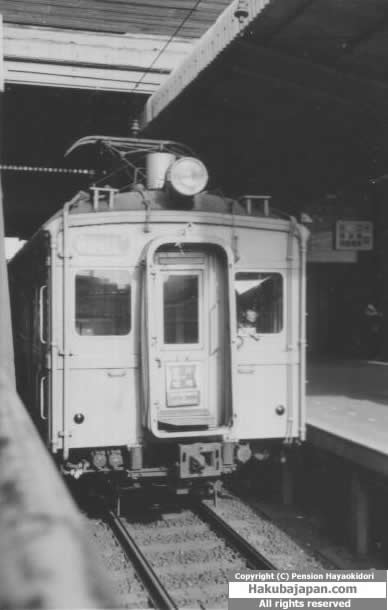
I don't remember what this serioes was. Maybe one of Kumoha 32 , 41, 51, 61 something like that. Anyway old JNR EMU train cars were unique each. It was also fun to learn which was which and what was different.
Local trains on Keihanshin-kanko line (Nishi-akashi <--> Kyoto) at the Yodogawa river railroad bridge.
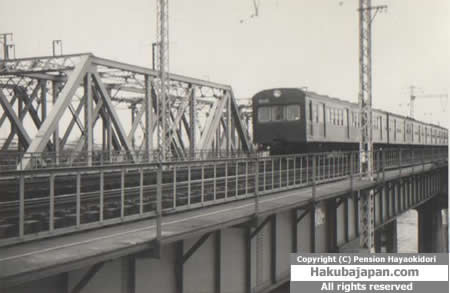
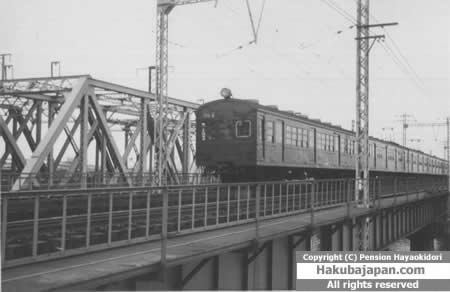
At that time, Keihanshin-kanko line local trains were already 7 train cars ones. With this type of old train cars, usually they made it 4+3. 4 at Nishi-Akashi side and 3 at Kyoto side to make 7. Sometimes I found all the 7 had control rooms at either side. In short, I guess they cared the control room of the 4th train car was forwarded Kyoto side and one of the 5th train cars was forwarded Nishi-Akashi side but didn't care others lol... It was fun to see for a kid. Old train cars at that time were all unique. Some had toilet, some had benches for people to be face to face in a limited space along window side. (We call it "box" sheet here in Japan) And some older ones showed a lot of rivets at their surfaces. Some had 4 doors on their side and others had 3. So wonder how they showed where the doors would be at the platform at that time. Can not check it as time has passed so long :o
As some short run train which ran from Koshienguchi <--> Suita were only 4 train cars, I guess they needed to make 7 with 4 + 3 to adapt it.
In both pics above, a Kuha79 is at the head. Depends on when they were made, their exterior and interior were slightly different as you see. I guess following cars were Moha72 etc. They didn't hang signboards to show their destination, did they?
This kind of old train cars had been replaced into 103 series commutor cars since 1969. If I remember right, they were completely replaced around 1977-1978.
I think these 2 pictures above were taken at the same date with the one of 481 series red skirt "Shioji" limited express train I showed while long ago, probably it was around 1972-73. Because 481 series was not in charge for "Shioji" limited express train in 1971 or before when 181 series train stayed in Mukomachi train cneter.
Diesel cars for express train. Kiha 65
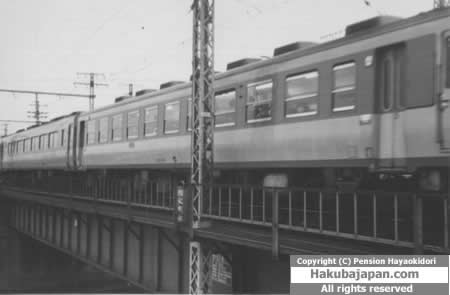
Thought this one below would be a kiha 58 Diesel car but...
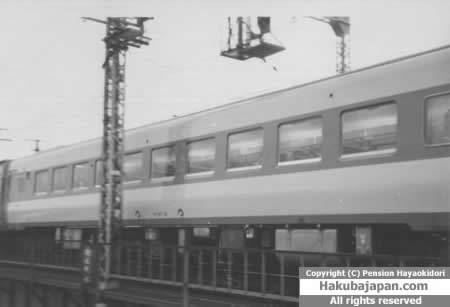
I guess there's a description which says "Kiha 57 4" at its side. Kiha 57 series was made to pass the Usui summit, this kiha 57 series DMU were phantoms and had air-suspensions at their boggies while their "buddy" series kiha 58 / 28 series didn't. If thr green car ( 1st class passenger car ) in the pic of kiha 65 were kiha 27, this DMU was an incredibly high percentage air-suspensioned one.
Subscribe to:
Posts (Atom)